Henri de Toulouse-Lautrec · 1892–1895
At the Moulin Rouge
Artificial light turns a social gathering into a theatre of uneasy faces.
Reading color and composition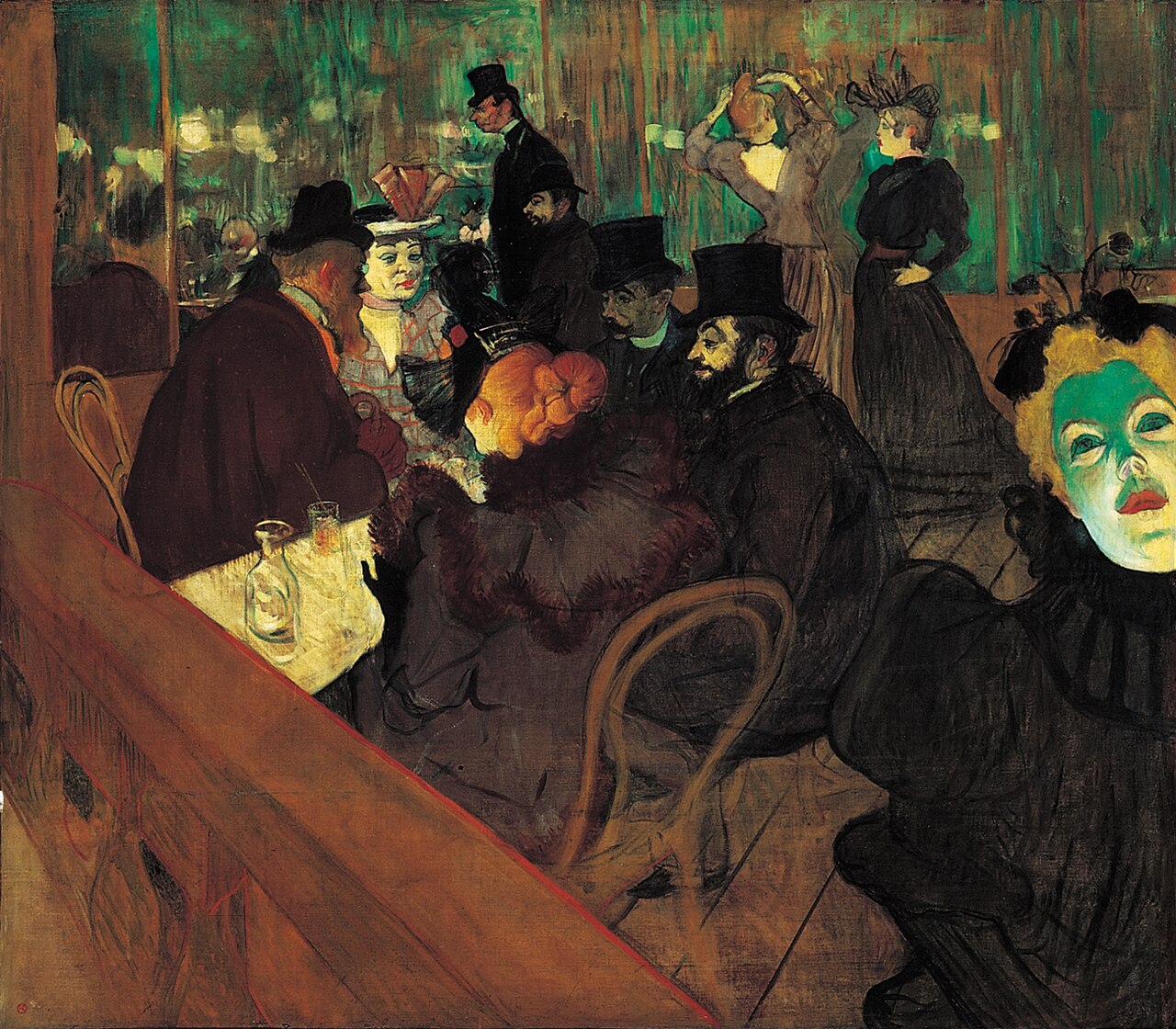
Reading color and composition
At the Moulin Rouge
Follow the diagonal barrier across the foreground towards the seated company. It separates our position from their table and makes looking feel like passing through a crowded room. Faces, collars and hats form a chain of pale and dark accents. The reflected figures deeper inside multiply the space without giving us a simple, stable overview.
Compare the sharp colour of the near face with the quieter faces around the table. The difference creates a rhythm of attraction and recoil: one head commands attention, then the group draws it back. Notice how cropped bodies and tilted lines resist a polished group portrait. The room becomes an experience of glancing, obstruction and artificial illumination.
Discussion of color and composition is the editorial team’s interpretation, not a claim to establish the artist’s intentions.
Henri de Toulouse-Lautrec
Context of the work
Context of the work
The Art Institute of Chicago dates this painting to 1892–1895. It depicts the Parisian entertainment venue named in its title.
Questions for looking
- Does the foreground face welcome or interrupt you?
- Which diagonal controls your route through the room?
Frequently asked questions
Is the green face a natural skin colour?
Its colour is better read in relation to the painting’s artificial lighting and surrounding contrasts.
Why attend to the cropping?
Cut edges make us feel physically near the crowd rather than safely outside it.
Sources and images
Official artwork record · Art Institute of Chicago
Image source and usage terms · Public domain · Henri de Toulouse-Lautrec