Honoré Daumier · 1864
The Third-Class Carriage
Inside a moving train, light quietly holds the nearest passengers’ hands and faces.
Reading color and composition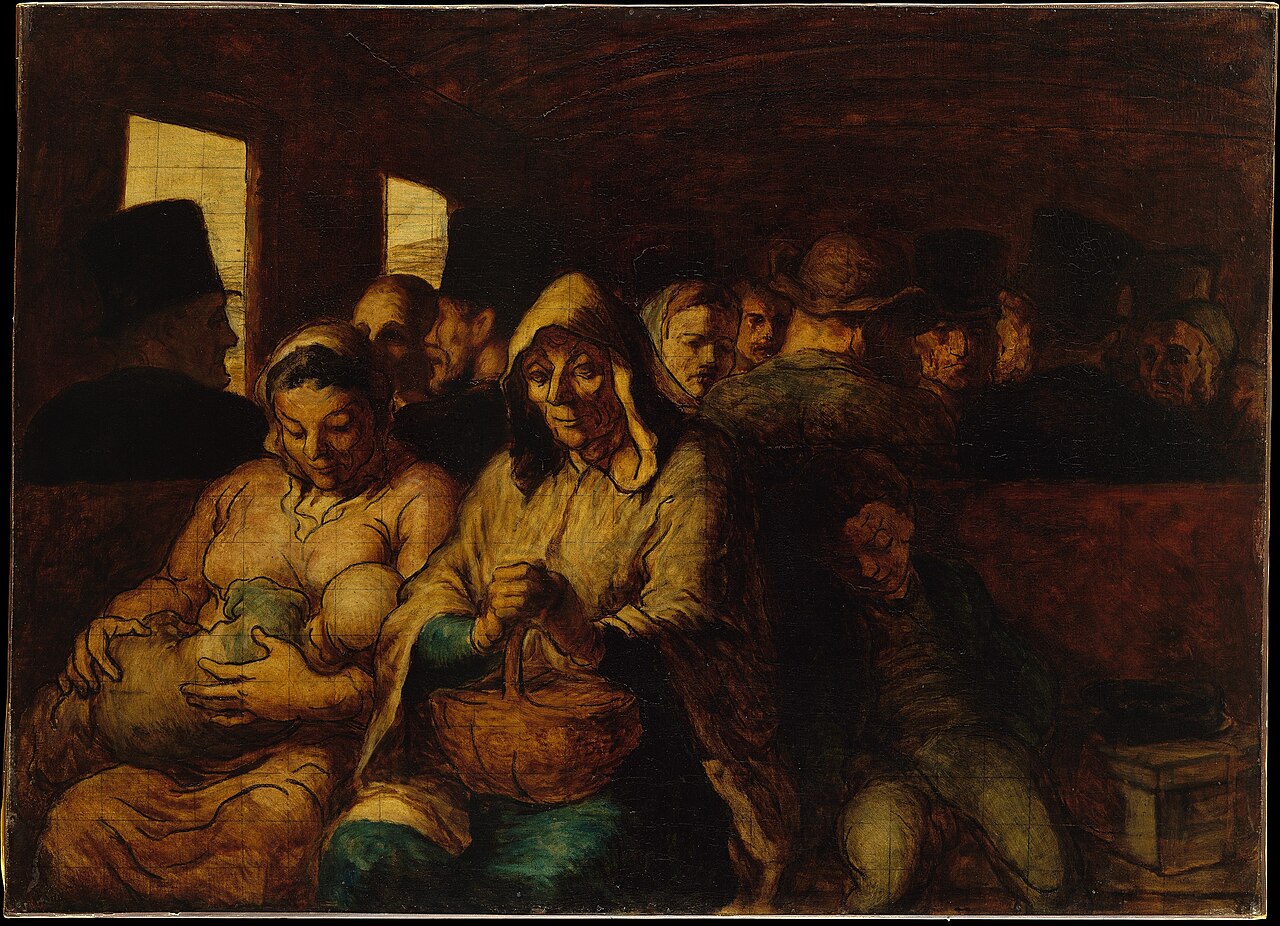
Reading color and composition
The Third-Class Carriage
Move from the central hands to the face, then to the arm enclosing the infant. Dark contours and brown planes give bodies weight. Light from the windows makes the people more legible than the world outside. Train speed is absent; what remains is the time a seated body must inhabit.
Compare the large foreground figures with the small faces behind. Depth is compressed even as the crowd grows. Broad clothes and hands contrast with the repeated little rhythm of hats. Unfinished lines reveal making alongside illusion. Avoid assigning poverty a single expression: sleep, care and waiting take different bodily forms within this shared compartment.
Discussion of color and composition is the editorial team’s interpretation, not a claim to establish the artist’s intentions.
Honoré Daumier
Context of the work
Context of the work
The Met currently dates its unfinished version to 1864.
Questions for looking
- Where is the journey centred when we see so little outside?
- How do different passenger sizes construct distance?
Frequently asked questions
Is this the same as the finished version?
This article concerns the Met’s unfinished canvas, distinct from the finished Ottawa painting.
Can an unfinished work be read closely?
Yes. Bodily relationships remain clear, and visible squaring lines also reveal part of the production process.
Sources and images
Official artwork record · The Metropolitan Museum of Art
Image source and usage terms · Public domain · Honoré Daumier