Henri Rousseau · 1910
The Dream
A sofa interrupts a jungle, making incompatible spaces feel continuous.
Reading color and composition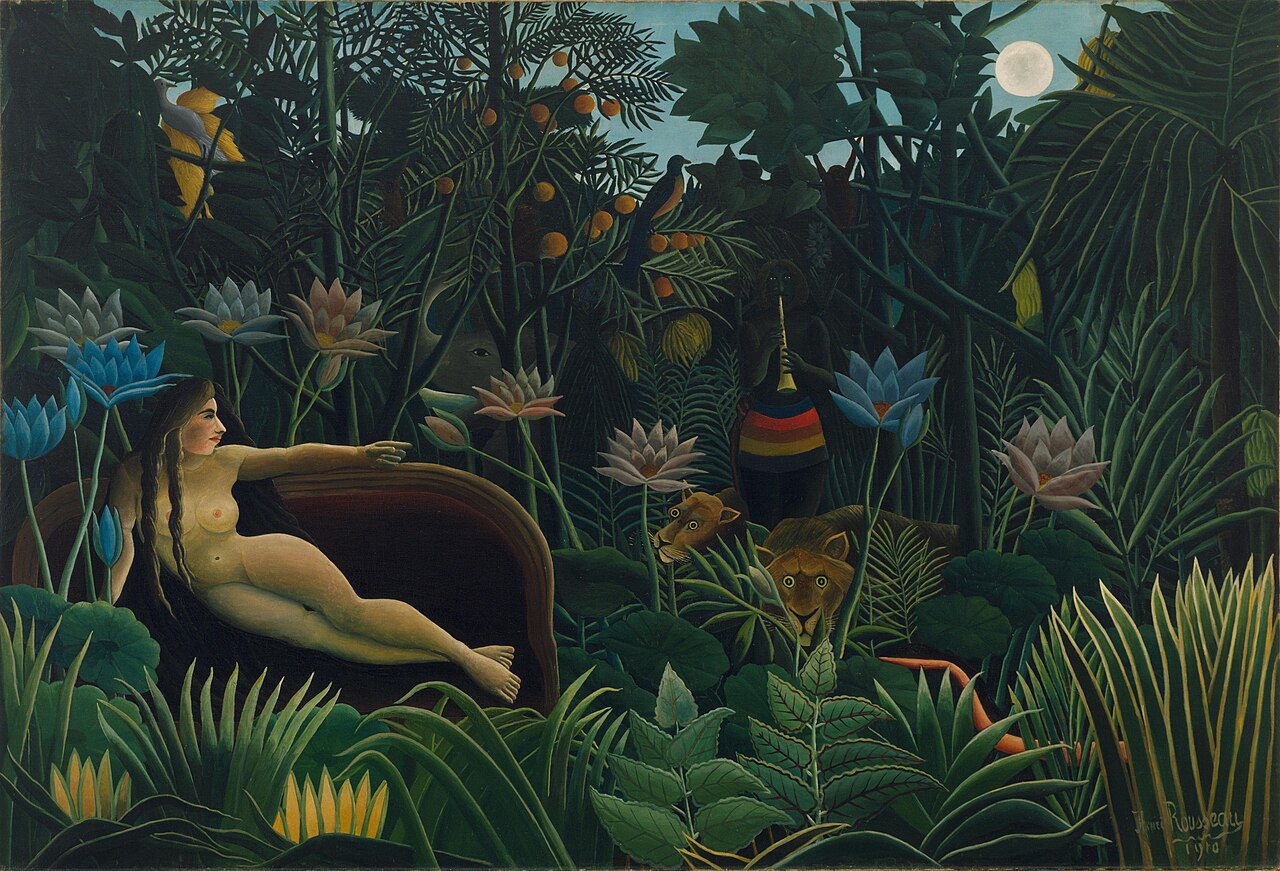
Reading color and composition
The Dream
Look for the animals between overlapping leaves. Some appear as watchful eyes before their bodies become legible. The central dark figure and instrument offer another pause in the dense surface. The moon above provides a small, clear circle against a forest of pointed and rounded shapes. No single patch of foliage needs to serve as a realistic botanical specimen.
Compare the sofa’s strong contour with the repeated edges of leaves. Both are firmly outlined, so furniture and forest share the same visual language. Depth comes in stacked layers rather than an open path we could walk. Move slowly from one shape to the next; the picture’s dreamlike quality develops through this coexistence of clarity and impossibility.
Discussion of color and composition is the editorial team’s interpretation, not a claim to establish the artist’s intentions.
Henri Rousseau
Context of the work
Context of the work
Rousseau painted The Dream in 1910. The work belongs to the Museum of Modern Art in New York.
Questions for looking
- Where does the domestic interior become jungle?
- Which animal did you notice only after looking longer?
Frequently asked questions
Is the sofa meant to fit the setting realistically?
Its conspicuous mismatch is a useful starting point for reading the imagined scene.
How does the jungle create depth?
Overlapping leaves and partly concealed figures build successive layers rather than a single clear corridor.
Sources and images
Official artwork record · Museum of Modern Art, New York
Image source and usage terms · Public domain · Henri Rousseau