Théodore Géricault · 1818–1819
The Raft of the Medusa
Bodies climb toward a distant speck, giving hope an unstable physical weight.
Reading color and composition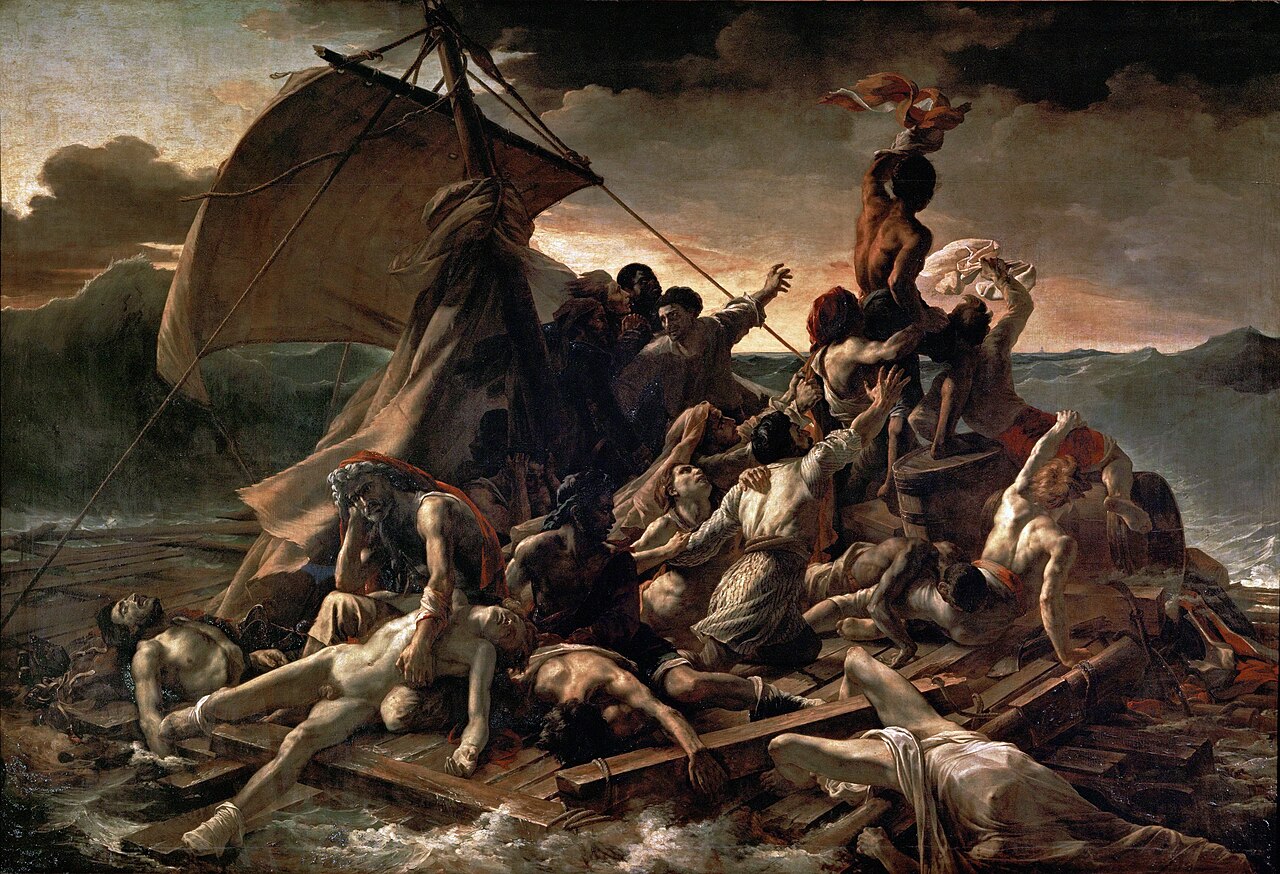
Reading color and composition
The Raft of the Medusa
Waves and diagonal planks deny the raft a stable floor. The human pyramid rises, while the sail and ropes at left pull another way. Compare these competing triangles: energetic movement above does not cancel the precarious support below. The eye can ascend even while the imagined ground seems to roll.
Study the foreground hands before searching the horizon. Close up, individual bodies feel heavy; from a distance, their combined effort resembles a small signal. The opening of pale sky beyond dark water need not promise safety. It can hold expectation open, asking the viewer to wait rather than supplying an immediate resolution.
Discussion of color and composition is the editorial team’s interpretation, not a claim to establish the artist’s intentions.
Théodore Géricault
Context of the work
Context of the work
Géricault made this Louvre painting in 1818–1819.
Questions for looking
- How does finding the distant vessel change the waving gesture?
- Do the sail and the human pyramid pull in the same direction?
Frequently asked questions
Why begin at the front?
Contrasting prone and upright bodies makes the upward movement more visible.
Is rescue already secure?
The composition suspends a moment of uncertain signalling. Distinguish knowledge of the story from what the painted distance actually reveals.
Sources and images
Official artwork record · Musée du Louvre
Image source and usage terms · Public domain · Théodore Géricault