Edvard Munch · 1893
The Scream
A straight bridge meets a landscape that seems unable to stay still.
Reading color and composition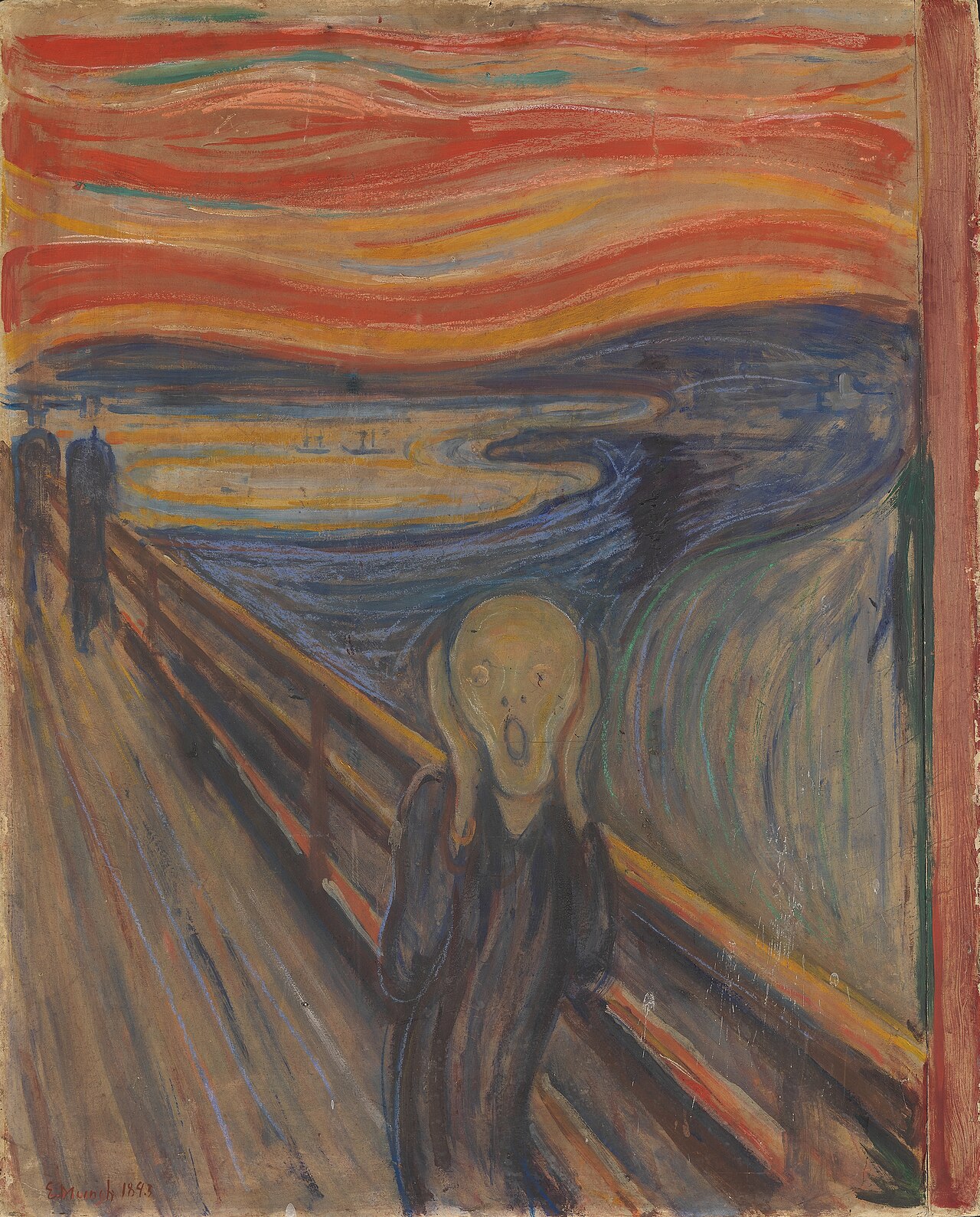
Reading color and composition
The Scream
Trace the bridge’s firm diagonal against the curling bands of water, land and sky. Two distant people remain upright and comparatively calm. Their small scale and separation sharpen the isolation of the foreground figure. The sky’s red-orange movement repeats the curves around the head, connecting human shape and landscape without making them literally identical.
Try viewing the work with the face covered. The surrounding bands still carry tension; expression belongs to the entire surface rather than the mouth alone. Then restore the face and observe how the straight railing becomes an unstable foothold. The painting does not require a precise diagnosis of the figure’s feelings to make that pressure perceptible.
Discussion of color and composition is the editorial team’s interpretation, not a claim to establish the artist’s intentions.
Edvard Munch
Context of the work
Context of the work
This is the National Museum of Norway’s painted version, dated 1893. Other versions exist, so the museum and date identify the specific work discussed here.
Questions for looking
- What remains expressive when the face is hidden?
- Do the distant walkers make the scene more lonely?
Frequently asked questions
Is this the only version of The Scream?
No. This article concerns the National Museum’s 1893 painting.
Is the figure necessarily shouting?
The open mouth permits that reading, but the surrounding landscape and covered ears leave the experience more ambiguous.
Sources and images
Official artwork record · National Museum, Oslo
Image source and usage terms · Public domain · Edvard Munch