Peter Paul Rubens · 1611–1614
The Descent from the Cross
Follow the transfer of weight through the many hands supporting one body.
Reading color and composition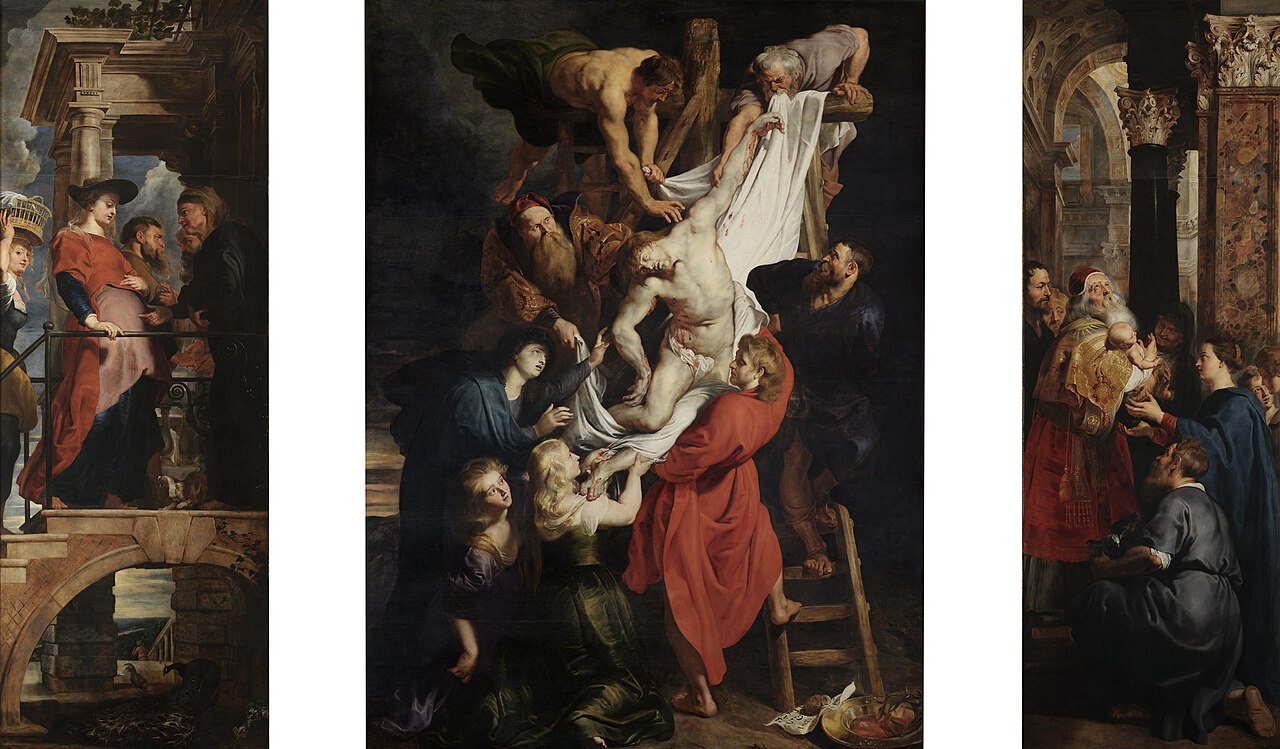
Reading color and composition
The Descent from the Cross
Descend slowly from the upper hands through Christ’s shoulder to the arms below. Arms directed differently meet the same body. White fabric provides a route for the eye, while darkness makes the curved boundaries of flesh and cloth more distinct.
Compare red and blue clothing at the bottom as coloured supports around the pale figure. After examining the centre, return to the wings. Their architecture and groups establish rhythms different from the strong central diagonal, restoring our awareness that the work has three parts.
Discussion of color and composition is the editorial team’s interpretation, not a claim to establish the artist’s intentions.
Peter Paul Rubens
Context of the work
Context of the work
Antwerp Cathedral dates the triptych to 1611–1614.
Questions for looking
- Which hand makes the body’s weight most tangible?
- Do the cloth and body travel in the same direction?
Frequently asked questions
Is the central panel the entire work?
No. This is a three-part altarpiece with two wings.
Which version is discussed here?
Rubens’s work at the Cathedral of Our Lady in Antwerp.
Sources and images
Official artwork record · Cathedral of Our Lady, Antwerp
Image source and usage terms · Public domain · Peter Paul Rubens