Salvador Dalí · 1931
The Persistence of Memory
When a clock loses its firmness, a landscape becomes strange.
Reading color and composition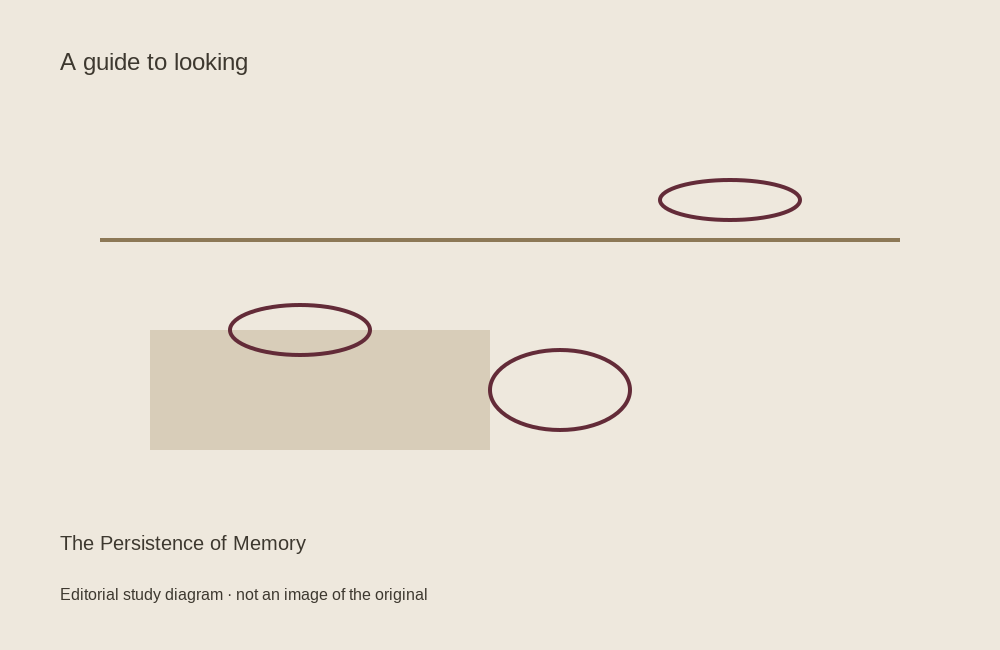
Reading color and composition
The Persistence of Memory
Compare the table’s rigid edge with the distant horizon. Between these straight lines, clocks bend around their supports: an instrument of exact measurement becomes a weighted surface.
Distant rocks remain comparatively clear, while the nearer pale form resists a simple name. Examine this reversal: distance feels recognizable and proximity uncertain.
Discussion of color and composition is the editorial team’s interpretation, not a claim to establish the artist’s intentions.


Salvador Dalí
Context of the work
Context of the work
MoMA dates this painting to 1931.
Questions for looking
- Which part looks most solid?
- What do you notice before reading a clock face?
Frequently asked questions
Is it a real landscape?
Plausible perspective and impossible objects coexist; identifying a place cannot explain everything.
Do the clocks mean only one thing?
Ideas about time are possible readings, not a single compulsory code.
Sources and images
Official artwork record · Museum of Modern Art, New York
Editorial study diagram · not an image of the original
View the original on the museum’s official page.