Berthe Morisot · 1872
The Cradle
Thin fabric softens the distance between a sleeping child and a watching face.
Reading color and composition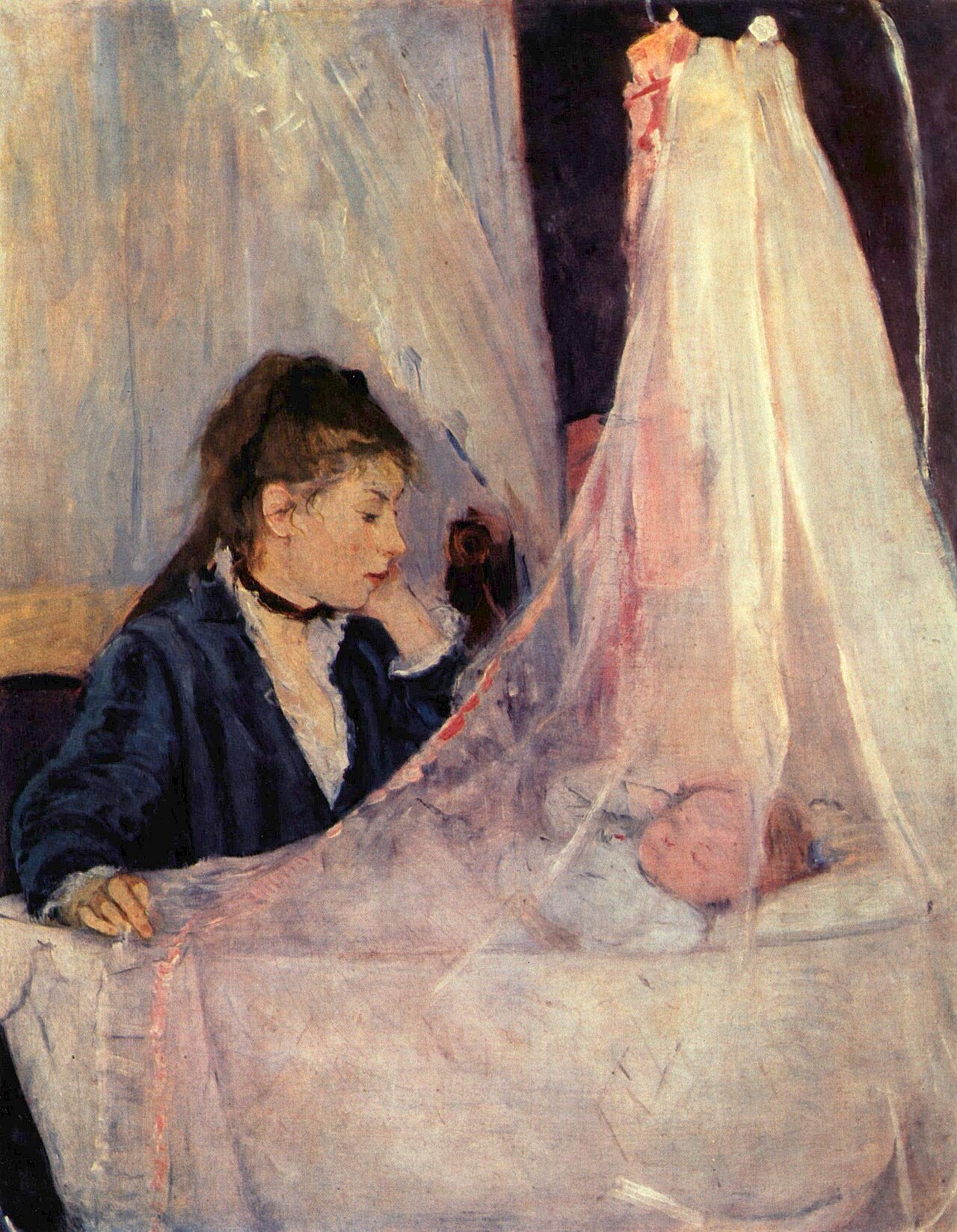
Reading color and composition
The Cradle
Compare the adult’s arm with the infant’s bent arm. Related curves appear at different bodily scales. Broad dark clothing makes face and hand brighter, while white fabric gently obscures the smaller body. Brightness does not automatically reveal everything; light can also make a screen.
Alternate between what is seen through fabric and the directly visible face. Care appears as sustained attention rather than a large action. Lively brushwork coexists with a posture that seems to continue quietly. We too can approach the child only to pause beyond the veil. Through that interval, intimacy becomes something other than unrestricted visual access.
Discussion of color and composition is the editorial team’s interpretation, not a claim to establish the artist’s intentions.
Berthe Morisot
Context of the work
Context of the work
Morisot painted this Musée d’Orsay work in 1872.
Questions for looking
- Would removing the fabric necessarily increase intimacy?
- Where do adult and infant arms echo one another?
Frequently asked questions
Is the white fabric merely decorative?
It organises light, concealment and the distance between bodies at once.
How does care become visible?
Through a sustained gaze, a supporting arm and the relation of quiet spaces rather than dramatic action.
Sources and images
Official artwork record · Musée d’Orsay
Image source and usage terms · Public domain · Berthe Morisot