Mary Cassatt · 1893
The Child’s Bath
A downward viewpoint gathers hands, feet and basin into one act of care.
Reading color and composition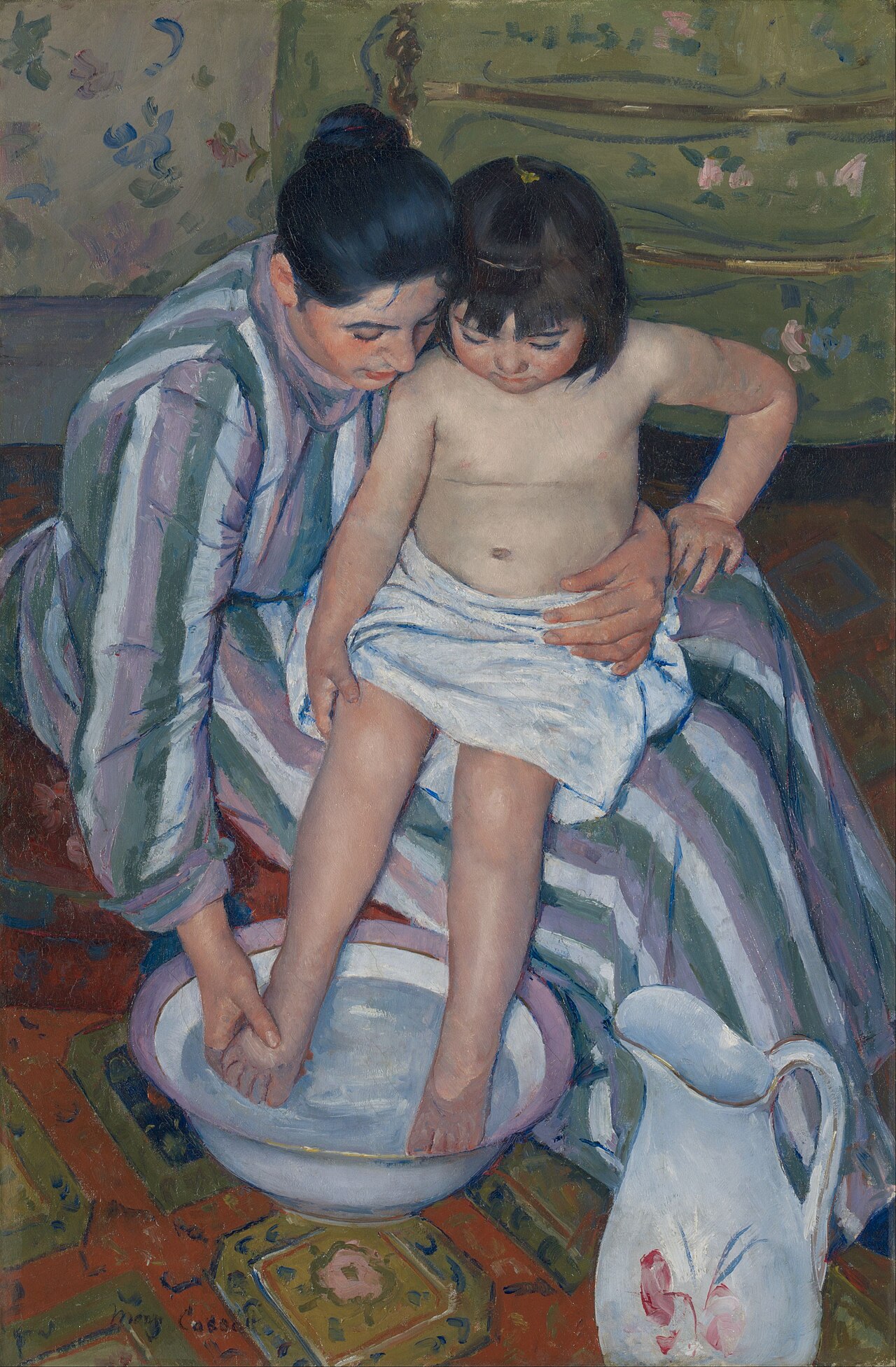
Reading color and composition
The Child’s Bath
Separate the arm supporting the body from the hand attending to the foot. One action maintains balance while another cleans. Care appears as a practical coordination of different tasks, without requiring a large emotional display. Looking downward makes support and touch more immediately readable than an outward-facing expression.
Follow the striped dress and repeated floor pattern, then stop at the basin’s ellipse. Decoration flattens the surrounding space, but bowl and bodies retain weight. Pattern and physical action need not compete: each can sharpen the other. Intimacy is felt through concentration on handling a small foot safely, not simply through confirming that a face looks affectionate.
Discussion of color and composition is the editorial team’s interpretation, not a claim to establish the artist’s intentions.
Mary Cassatt
Context of the work
Context of the work
Cassatt painted this Art Institute of Chicago work in 1893.
Questions for looking
- Would an eye-level view make the hands and feet less prominent?
- How do the stripes contrast with the basin’s ellipse?
Frequently asked questions
Do all the hands perform the same task?
Distinguishing support from washing reveals the coordinated balance of care.
Do the patterns hide the action?
Their contrast with skin and basin can make the points of contact clearer.
Sources and images
Official artwork record · Art Institute of Chicago
Image source and usage terms · Public domain · Mary Cassatt