Hans Holbein the Younger · 1533
The Ambassadors
Find a distorted skull beneath an orderly display of intricate objects.
Reading color and composition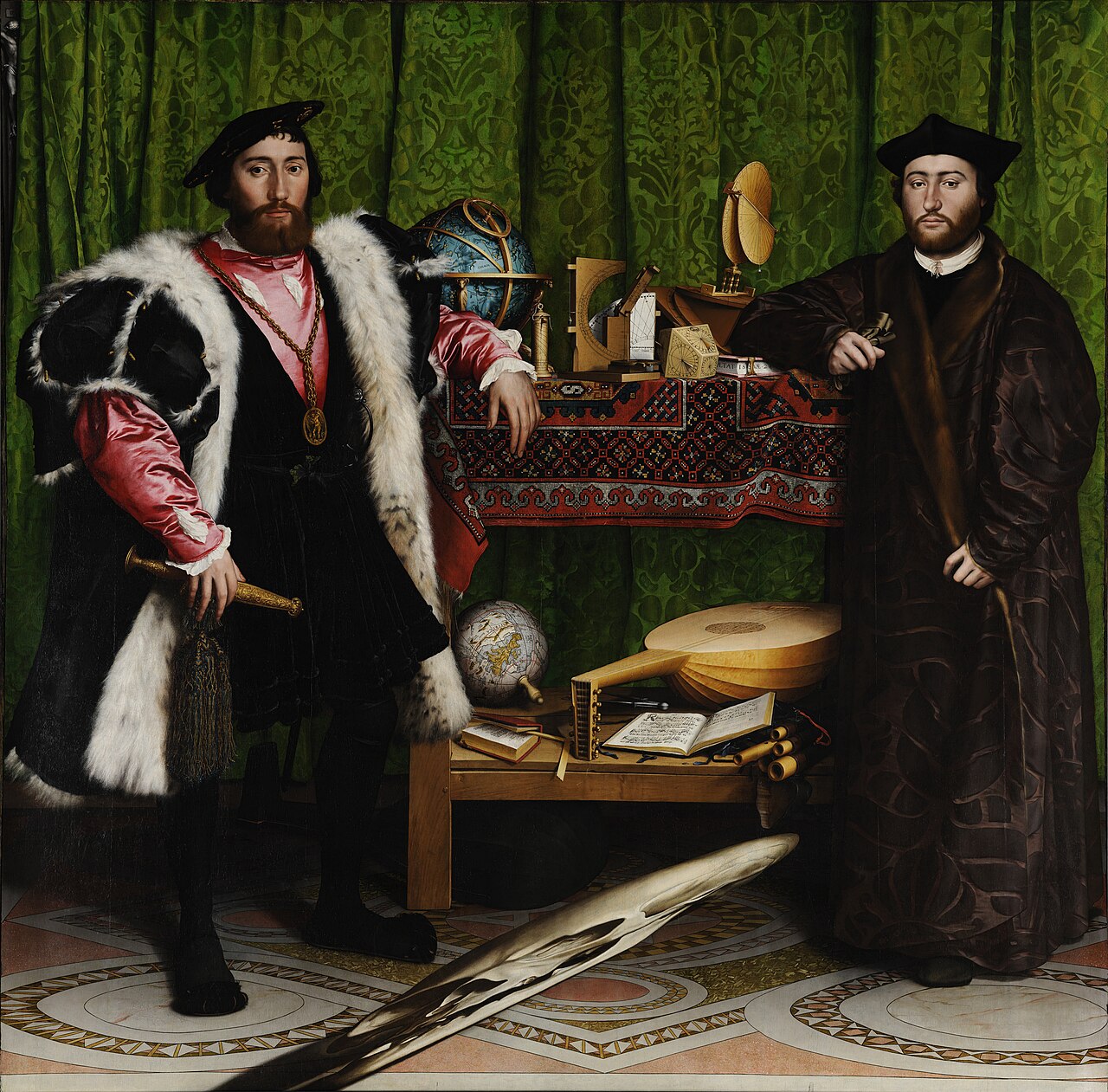
Reading color and composition
The Ambassadors
Move horizontally from faces to possessions. Rounded globes and the angled lute suggest depth, while straight shelves hold them in a line. Objects occupy enough space and detail to keep attention moving between the men and the things around them.
The floor shape is an anamorphic skull, legible from an oblique viewpoint. What looks convincing from the front and what requires a different position coexist in one image. Tilting an online reproduction is not equivalent to moving sideways before the physical painting; the distinction helps explain why viewing position matters.
Discussion of color and composition is the editorial team’s interpretation, not a claim to establish the artist’s intentions.
Hans Holbein the Younger
Context of the work
Context of the work
The National Gallery records the date as 1533.
Questions for looking
- Which object catches your attention before either face?
- How does the floor shape disrupt the shelves’ order?
Frequently asked questions
Why is the skull stretched?
It is constructed to become recognisable from a particular oblique viewpoint.
Do all the objects have similar surfaces?
Compare the different light on fur, metal, wood and fabric.
Sources and images
Official artwork record · National Gallery, London
Image source and usage terms · Public domain · Hans Holbein the Younger